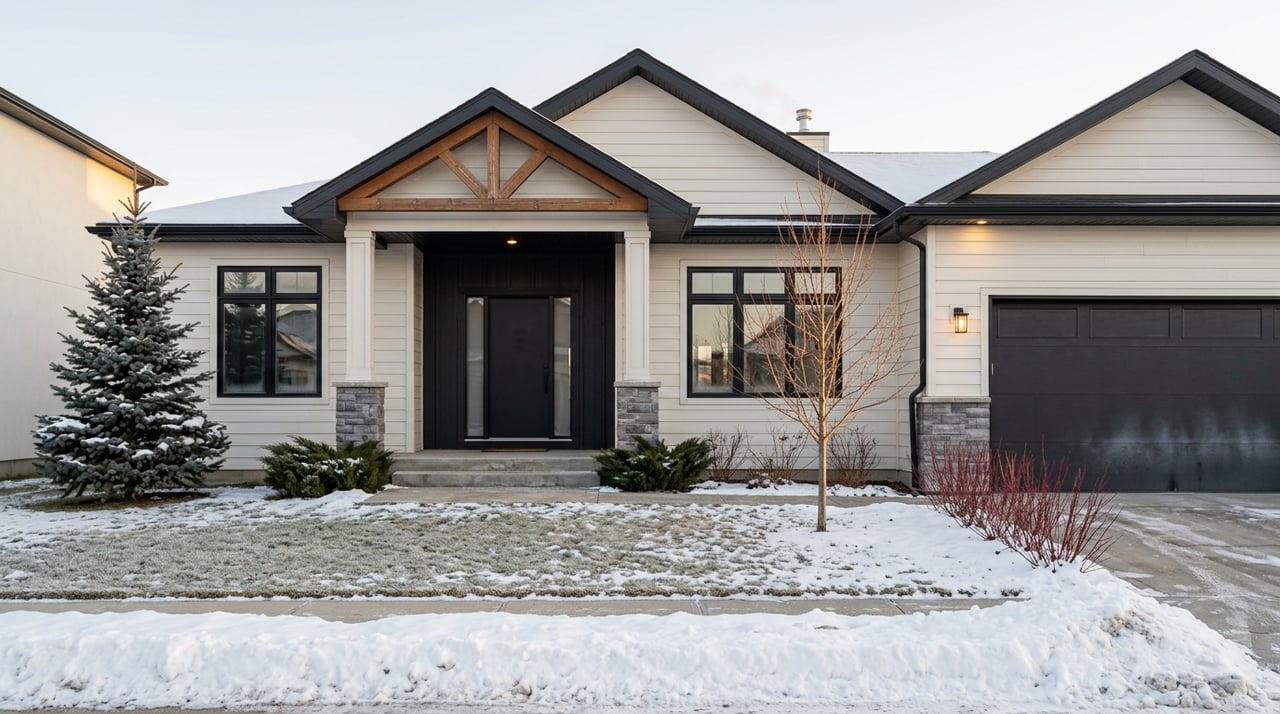
Pull up any portal and Paradise Canyon reads like a single market with a single price. Recent aggregate snapshots put the average asking price somewhere between the mid-$360s and low $410s, with a ceiling above $1.15 million and a floor near $99,000. That range is not noise. It is the story. Treat the average as the answer and you will underwrite the wrong home, in the wrong part of the neighborhood, with the wrong reserve for costs that never appear on the listing card.
The real Paradise Canyon is two markets stitched together by a golf course, a homeowners association, and a bedrock geology problem. Here is what a buyer actually needs to hold in their head before writing an offer.
The average is the wrong number
Averages describe a middle. Paradise Canyon does not have one.
The neighborhood is roughly seventy percent detached single-family and thirty percent attached, with about eighty-five percent of dwellings owner-occupied and most stock built after the year 2000. A market with that little rental churn and that much custom construction does not regress to a mean. It clusters at two poles: entry-level attached product and executive detached homes, with a thin middle where the average number lives.
That is why you can see a two-bedroom townhouse listed near $294,900 and a Douglas Bergen designed, Bezooyen built bungalow with five thousand square feet of living space in the same neighborhood search. Both are Paradise Canyon. Neither is the average. A buyer benchmarking off a portal figure is comparing themselves to a home that does not exist.
Two benches, two markets
Paradise Canyon sits on two levels, and the level matters more than the address.
The upper bench, marketed at times as Canyon Crest, is predominantly single-family detached on standard urban lots. This is where you find walkout bungalows on the coulee edge, executive two-storeys, and the deepest concentration of custom builds. Views here are of the coulees, the Oldman River valley, and in some homes, the CP rail bridge on the horizon.
The lower bench, closer to Paradise Canyon Golf Course, is a hybrid: single-family homes woven in with condominium product and townhouses. Lots on this bench that back the course carry a different cost structure than anything above them, and that is where the hidden mechanism lives.
A buyer who wants a walkout with a fairway view is shopping the lower bench. A buyer who wants a coulee view and a conventional detached lot is shopping the upper. The two benches trade against different comparables. Pricing them off a blended average is how buyers overpay for the wrong exposure.
The friction stack on golf-course lots
Read a lower-bench lot listing carefully and a pattern appears.
Golf-course-backing building lots in Paradise Canyon commonly disclose condo fees in the neighborhood of $170 per month, HOA dues owing on completion of the home, a pre-completed geotechnical report, and, on some parcels, a sale price that already includes the cost of pinning the future foundation to bedrock. Others state plainly that GST is additional to the listed price.
None of that is exotic. All of it changes the math.
| Line item | What it looks like on a Paradise Canyon lot |
|---|---|
| Condo fee on a building lot | ~$170/month, disclosed on MLS |
| HOA dues | Payable on completion of the home |
| Geotechnical report | Often pre-ordered and included |
| Foundation pinning to bedrock | Sometimes bundled into lot price, sometimes not |
| GST | Applies to new construction and vacant land sales |
| Yard care and snow removal | Included in some HOA lot arrangements |
A buyer who models a lower-bench build off the raw land price alone misses several thousand dollars a year of carrying cost and, in some cases, a five-figure structural line item at the foundation stage. The reason bedrock pinning shows up in listing remarks at all is that Paradise Canyon sits on the coulee edge, and geotechnical conditions vary parcel by parcel. That is why the same neighborhood has lots priced under $100,000 and lots priced well into the $200s: the geology, not just the view, is priced in.
The builder ecosystem does the resale work
Paradise Canyon is one of the few Lethbridge neighborhoods where the builder's name shows up in the listing description as a value cue. Bezooyen bungalows, Galko show homes, and Douglas Bergen designed contemporaries are named in current and recent MLS remarks. That is a resale signal, not marketing filler.
For a buyer, it means two things. First, comparables cluster by builder as much as by square footage. A Galko former show home and a builder-grade spec of the same size are not the same trade. Second, when you resell, the buyer on the other side will know the name too. Paying a premium for a documented custom build in this neighborhood tends to be defensible on the way out in a way that paying a premium for finishes in a commodity subdivision is not.
The corollary: an older Paradise Canyon home that has not been touched since the early 2000s is competing against nearly new custom product on the same street. Renovation math here is not optional. It is part of the underwriting.
Where the mid-2026 market actually sits
Citywide, Lethbridge is moving toward more balanced conditions. The benchmark price has continued to trend up, but the monthly gain has slowed to under one percent, average sold prices have softened month-over-month while remaining up roughly seven percent year-over-year, and inventory has continued to rise across property types. That is the backdrop.
Inside Paradise Canyon, the neighborhood-level aggregate has moved in a narrow band across 2025 and into 2026. Snapshots pulled in August 2025 showed an average asking price near $364,000 with a top listing at $709,900. By late 2025, aggregators were showing averages between roughly $381,000 and $412,000 with the ceiling back above $1.15 million. Those swings are not the neighborhood repricing. They are the mix of what happens to be listed on a given day in a small, thin market. Three luxury listings enter, the average jumps. Two townhouses enter, it drops.
The takeaway for a buyer: do not track this neighborhood's monthly average. Track the bench, the builder, and the lot conditions. Everything else is noise.
Questions buyers ask before writing an offer
Is a condo fee on a vacant lot normal here? On golf-course-backing lots inside the HOA structure, yes. It typically funds shared services like yard care and snow removal on the common areas around the course-side properties. Read the specific lot disclosure. The number and what it covers vary.
How much of the price gap between upper and lower bench is view versus structure? Both. Upper-bench walkouts pay for coulee and river views. Lower-bench homes on the course pay for fairway exposure plus, in some cases, the geotechnical work already done on the parcel. A lot with a completed geotech report and bedrock pinning priced in is not comparable to a raw lot at a lower sticker.
Are there schools inside the neighborhood? No public or primary schools sit within Paradise Canyon itself. Buyers with school-age children should confirm current catchment assignments with the relevant division rather than relying on portal data.
What should I ask for during conditions? On a resale, a current Real Property Report and a review of the HOA and any condo bylaws governing the property. On a lot, the geotechnical report, written confirmation of what the price does and does not include (pinning, GST, HOA activation), and the schedule of dues owing on completion.
Working the neighborhood, not the average
Paradise Canyon rewards buyers who stop shopping the portal average and start shopping the parcel. Which bench. Which builder. What the HOA and condo documents actually say. What the geotech report shows. Whether GST is in or out. Those are the numbers that decide what your dollar buys here, and none of them are on the map pin.
If you are weighing a Paradise Canyon purchase or thinking about listing a home you already own on either bench, Blackstone Real Estate can walk you through the comparables that actually apply to your parcel and pull a data-backed valuation against them. Request your free home valuation or reach out to talk through a specific listing on the Paradise Canyon page.